The art of social comment
Three prominent artists, all Trinity alumni, offer perspectives on their art and its contribution to social discourse.


Can art change people’s perceptions? Does it have to have a message? And, in modern times, increasingly fraught by challenges – from war and terrorism to climate change – does art have a clear role to play?
Red Hong Yi, a Malaysian-born installation artist and architect (TCFS 2004), says the chance to influence how people see the world is one of the reasons why she creates.
Red looks back fondly on her time at Trinity. ‘It was a year of growth, learning and great friendships,’ she says, and it was also when she was ‘encouraged to think critically in class, no matter the subject’.
‘Trinity was my introduction into learning how to gather factual information and analyse these sources.’
Red has taken that critical thinking powerfully into her artistic endeavours. Her works are often large scale and notably involve unconventional materials – tea bag tabs, books, chopsticks, socks – often in large volumes, inviting viewers to think differently about the mundane objects around them.
One of her works, Seeds of Seduction, is a portrait of Chinese artist and activist Ai Weiwei, which uses 20,000 sunflower seeds, a reference to Ai’s own work in which he portrayed the sunflower seed as a revolutionary symbol and of childhood poverty in China.
Home, memories and belonging have been constant themes in Red’s work. Currently, she is working with four Burmese refugees on a series of artworks featuring thousands of hand-sewn buttons. The four 'have been forcibly displaced, their ideas of "home" have been fractured and redefined,' she says.
‘I do believe art can shift people’s perspectives, spark emotion and invite reflection … it can resonate emotionally and can linger in people’s minds.’

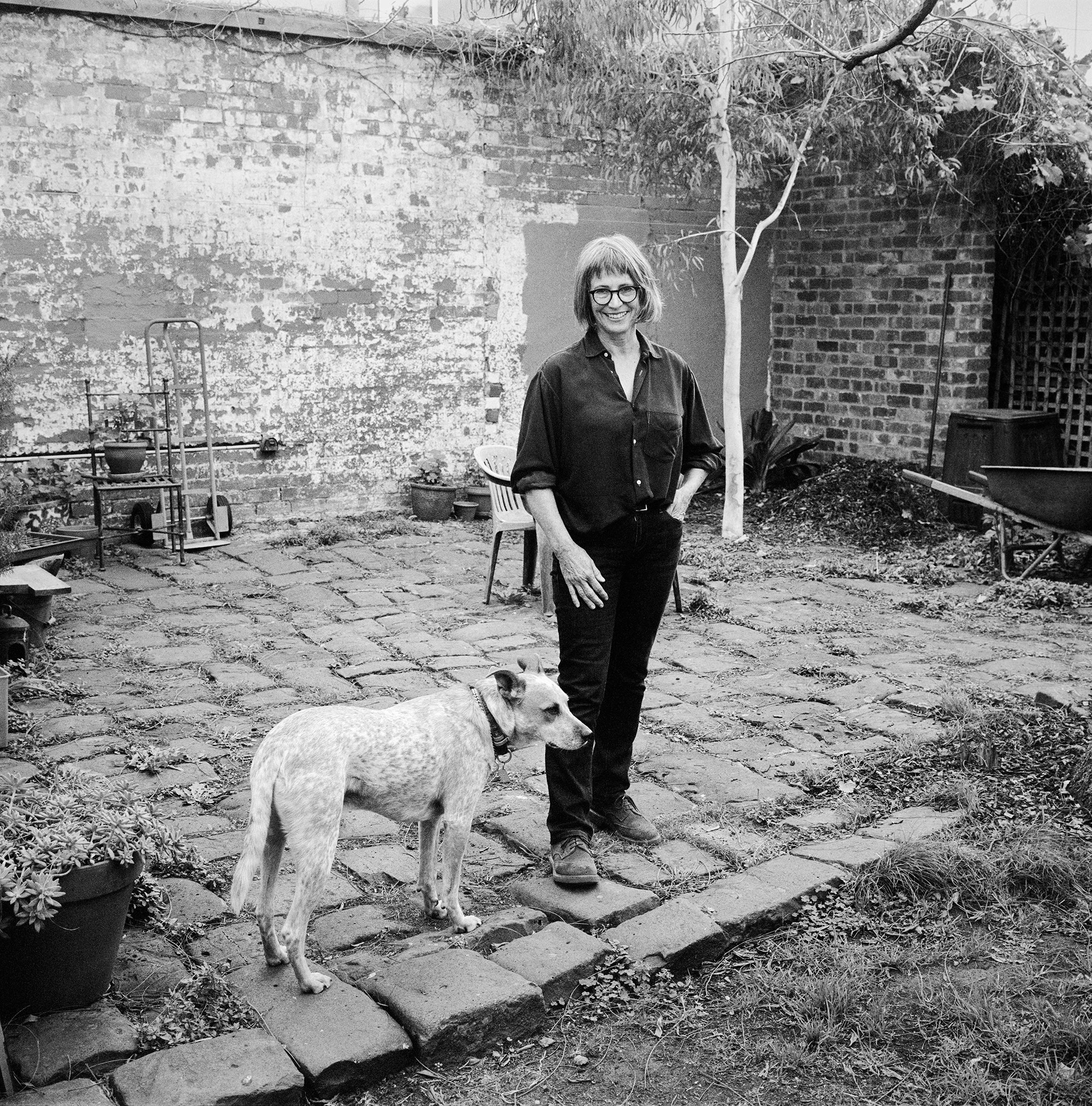

Kristin Headlam. PHOTO BY MARK MOHELL.
Kristin Headlam. PHOTO BY MARK MOHELL.
For Kristin Headlam (TC 1975), whose wide-ranging figurative art career spans decades of painting, drawing and printmaking, art is about putting the images out there and letting people take what they will. For Kristin, ‘art is really a question more than an answer.’
She remembers her time at the College in the 1970s as social and collegiate. ‘A lot of my friends came from that time. I felt amongst a group I could relate to – they were serious,’ she says, referring to a quality she obviously values and one that is evident in the thoughtful way she discusses her work.
After finishing her Fine Arts degree, Kristin increasingly realised that ‘art was important to me … I wanted to be an artist,’ and she enrolled at the Victorian College of the Arts.
'Art is really a question more than an answer.'
She lived in Bangkok for more than three years, where she allowed her artwork to respond to the world around her. ‘Not the temples and the tourist images, but to the life I could see from my apartment.’ While her subjects have been remarkably diverse, her art has always been figurative and keenly observational.
In the early 2000s, Kristin’s work took a more sombre turn. She began to use photos and images drawn from mainstream media and repurpose them, painting scenes of disaster, refugees and soldiers. ‘I cut out a lot of colours and did them in a version of grey,’ she explains.
In Exodus (2002–03), for example, she showed New Yorkers fleeing after the bombing of the World Trade Centre on 11 September 2001. The monochromatic painting captures the destruction, chaos and bewilderment of that day.
In Kristin's view, it's up to the viewer to take away whatever they like. 'For the most part in my paintings, I just want to say, "This is what I see; can you see it?"'
Ross Bastiaan AM RFD (TC 1969) has created a unique series of bronze plaques that commemorate Australian history – and impart a message.
Ross was at the College in the 1960s, and ‘loved the history of Trinity, the culture of knowledge and education ... and I loved being introduced to the non-science part of life’. Although always good at drawing, Ross chose science and has had an impressive career as a periodontist and forensic dentist, but the ‘non-science part of life’ that he has pursued has been equally impressive.
When he visited Anzac Cove in 1990, he was shocked to find nothing in English explaining the battle at Gallipoli. He decided to produce a series of plaques for the site, featuring the WWI campaign. ‘I felt passionately that Australia was losing part of its history,’ he says. ‘People didn’t know what had happened. I had a long-term vision.’
That vision has stretched for decades. His first plaques were all words, but he realised he needed to elaborate. 'I cottoned onto a vital element,' he says. 'You have to put something graphic on the plaque. The picture is the winner.'
Ross honed his sculpting skills, training with Ray Ewers, a renowned Australian sculptor. He works up a drawing, translates it into bas-relief, and has the works cast in bronze.
Since that first Gallipoli series, Ross has drawn, cast and installed more than 270 interpretive plaques in 20 countries, honouring those who have fought and fallen in battle. He has raised around $1.2 million to help fund the projects (his work is voluntary).
‘I felt passionately that Australia was losing part of its history. People didn’t know what had happened. I had a long-term vision.'
The message in his artwork varies. ‘At the Menin Gate in Ypres, it was cynical,’ he explains. ‘I talk about the wastage, the terrible loss of life for limited gain.’ More recently, he has worked on plaques commemorating feats such as the construction of Victoria’s famed Great Ocean Road, and there is pride in the achievement.
‘I have tried to use my art to highlight the effort that our country has made.’
Below: Ross in his studio.
Image credits:
Red Hong Yi, by Annice Lyn
Kristin Headlam, by Mark Mohell
Ross Bastiaan, by Yanni for Mornington Peninsula News
READ NEXT STORY >>> TOUCHING THE SKY
<<< BACK TO LEAVING THEIR MARK
 Built with Shorthand