
Saints &
sinners
Trinity's stained-glass windows
Trinity Today 2025 | By Caroline Miley

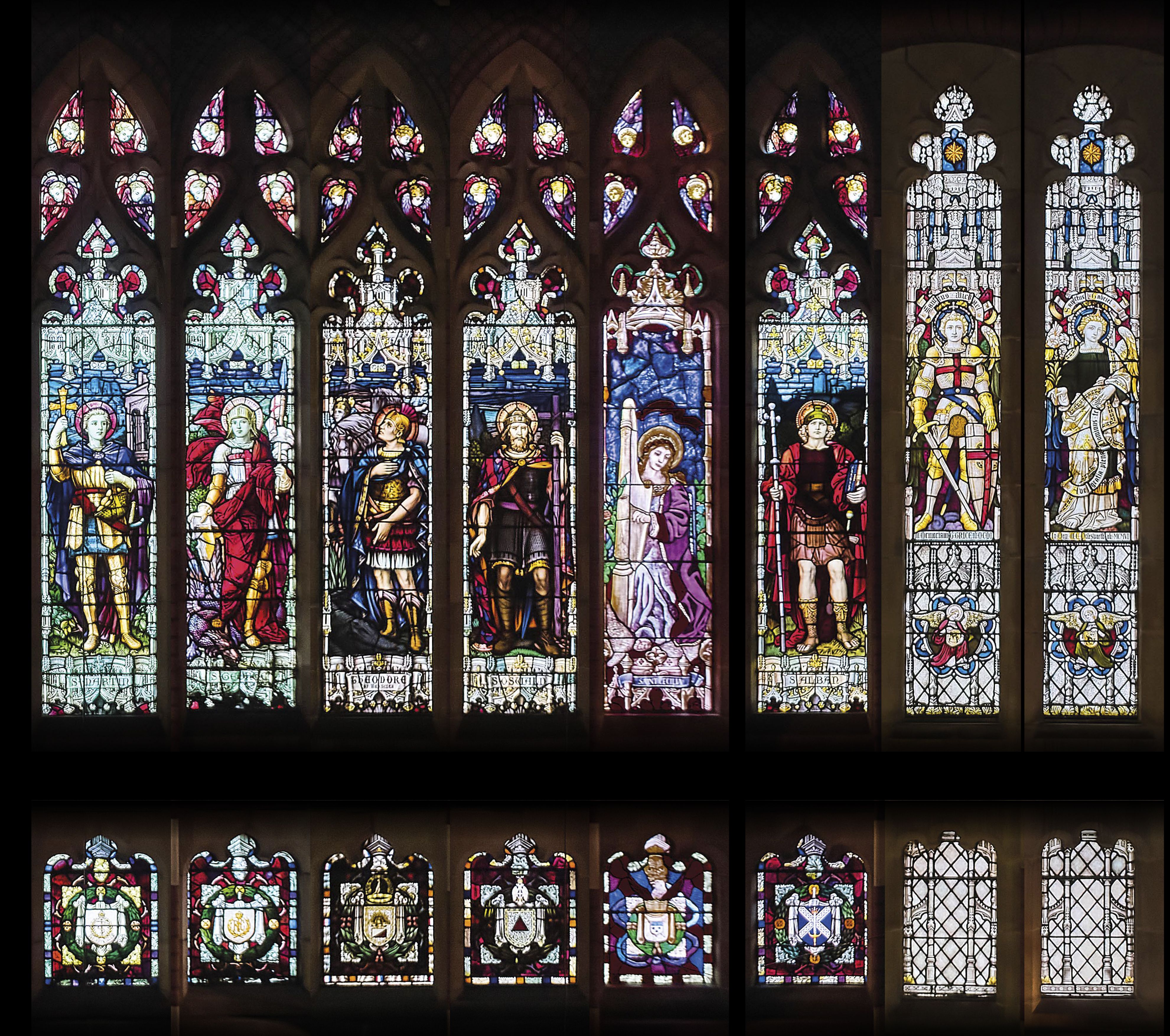
An important part of Trinity College’s art collection is its fine array of stained glass. It includes works by leading Melbourne and English artists of the late 19th and early 20th centuries, and the stories of its acquisition speak loudly of the history of the College and its students.
It is not surprising that much of the glass takes the form of war memorials. There is hardly a boys’ school or college in Australia that does not have a similar collection, and the rows of dedicatory inscriptions bear witness to the immense contribution made to the service of King and Empire by the men who willingly volunteered.
At Trinity, the earliest such memorial is to Lieutenant George Grice who fell in the Boer War, while the great east window in the Horsfall Chapel is a tribute to the 41 alumni who died in the Great War, and its nave windows are also war memorials.
The unselfconscious ‘Englishness’ of the themes expresses the Anglican nature of the College and celebrates the faith and heritage of its founders.
When the College opened in 1872 there was no Chapel. The students’ Common Room (now the Warden’s Office, in the Leeper building) was used for daily prayers and, in 1878, was fitted up as a Chapel. It is a handsome room with a bay of five large lobed windows with oculi.

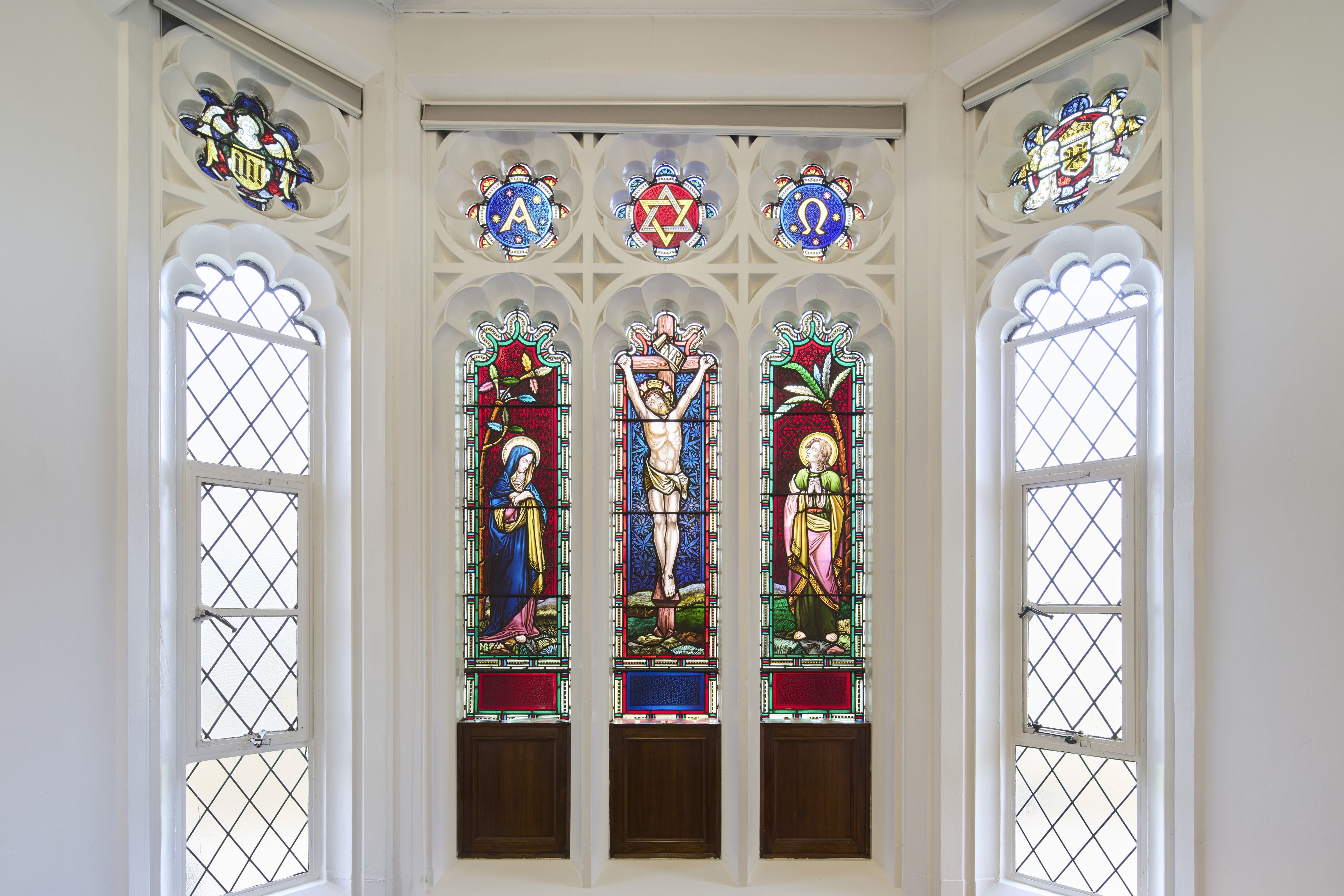
The installation of a three-light of the Crucifixion, by the prominent Melbourne company of Ferguson and Urie, gave the room an ecclesiastical character. This is the oldest stained glass in the College and is a fine example of the firm’s work, likely made by David Relph.
In 1903, two side lights of the archangels St Michael and St Gabriel by the English firm of Clayton and Bel were installed. They may have been inspired to commission Clayton and Bell after seeing the full suite of glass by that company installed in St Paul’s Cathedral 10 years earlier. The Perry room in Leeper has an identical bay window, filled with plain leadlight but for the College’s coat of arms in the central oculus.

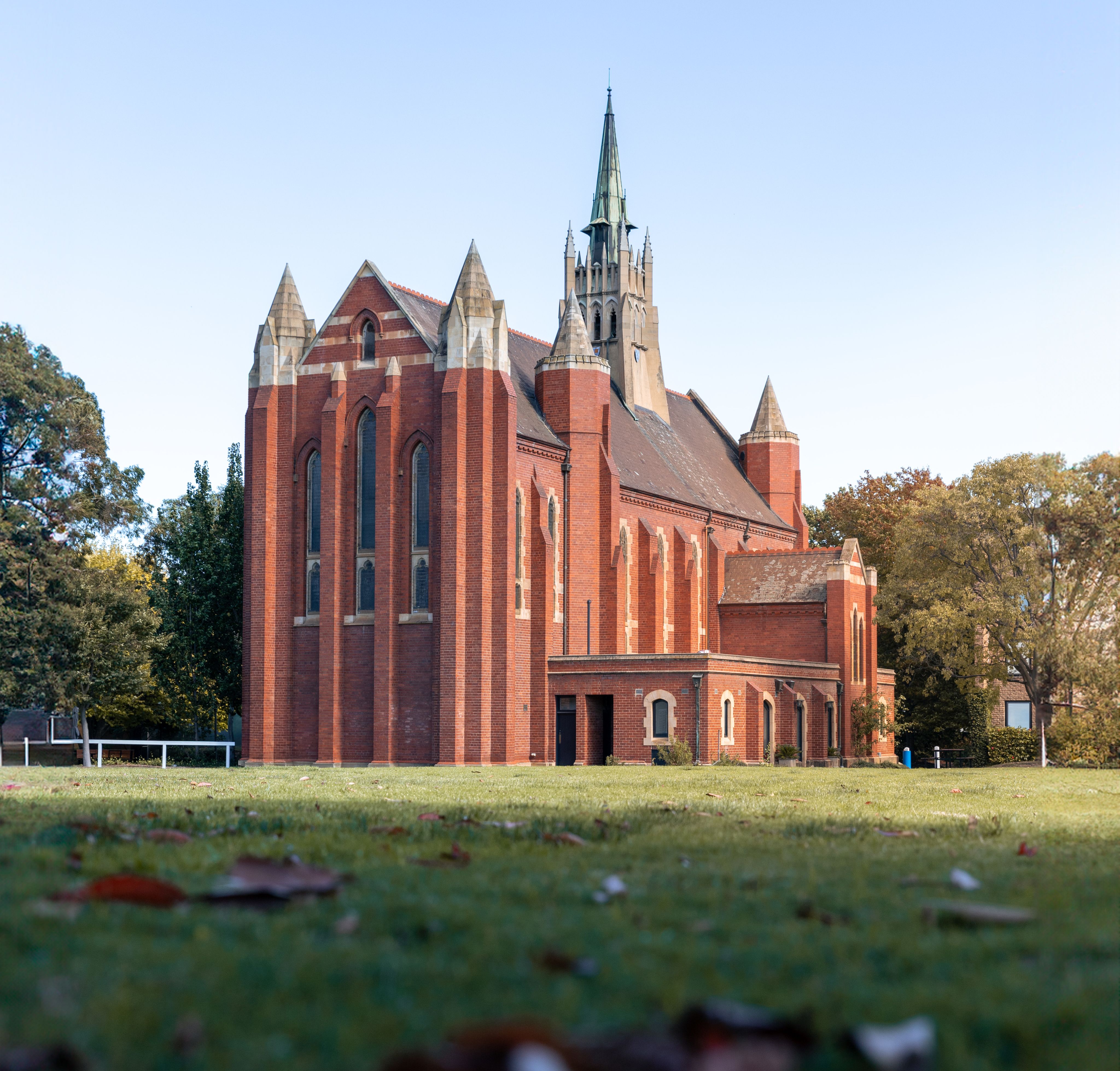

The Horsfall Chapel, commissioned before the War and opened in 1917, is ornamented with an excellent set of early 20th-century stained glass by several artists, designed according to an overall scheme in style and content. The Chapel’s dedication is to the Holy Trinity, and it was donated by businessman John Horsfall as a memorial to his daughter, Edith Carington.
By the time it was built, however, the Great War was in progress and parents of College men who died were anxious to commemorate them in glass.
The Warden and the architect Alexander North understood the importance of a coherent program of glass and devised a scheme that focused on early English warrior saints. Despite the work being by several hands, adherence to the design concept ensured that the glass both complemented the architecture and conveyed a unified message of duty and sacrifice.
The sanctuary is dominated by a three-light of the Crucifixion (1939) with base panels by William Kerr-Morgan, an English artist employed by the large Melbourne firm of Brooks Robinson. The base panels contain ancillary scenes: the soldier St Sebastian, the Emperor Constantine and St John Gualberto. Two lancets in the side walls, of the archangels St Michael (Grice Memorial) and St Gabriel, were relocated from Leeper to the Horsfall Chapel in 1916, with base panels by Melbourne artist William Montgomery to make them fit the new openings. Montgomery also created in 1917 a St Alban window (O’Hara Memorial) in the sanctuary.
Below: a selection of panels from Horsfall Chapel

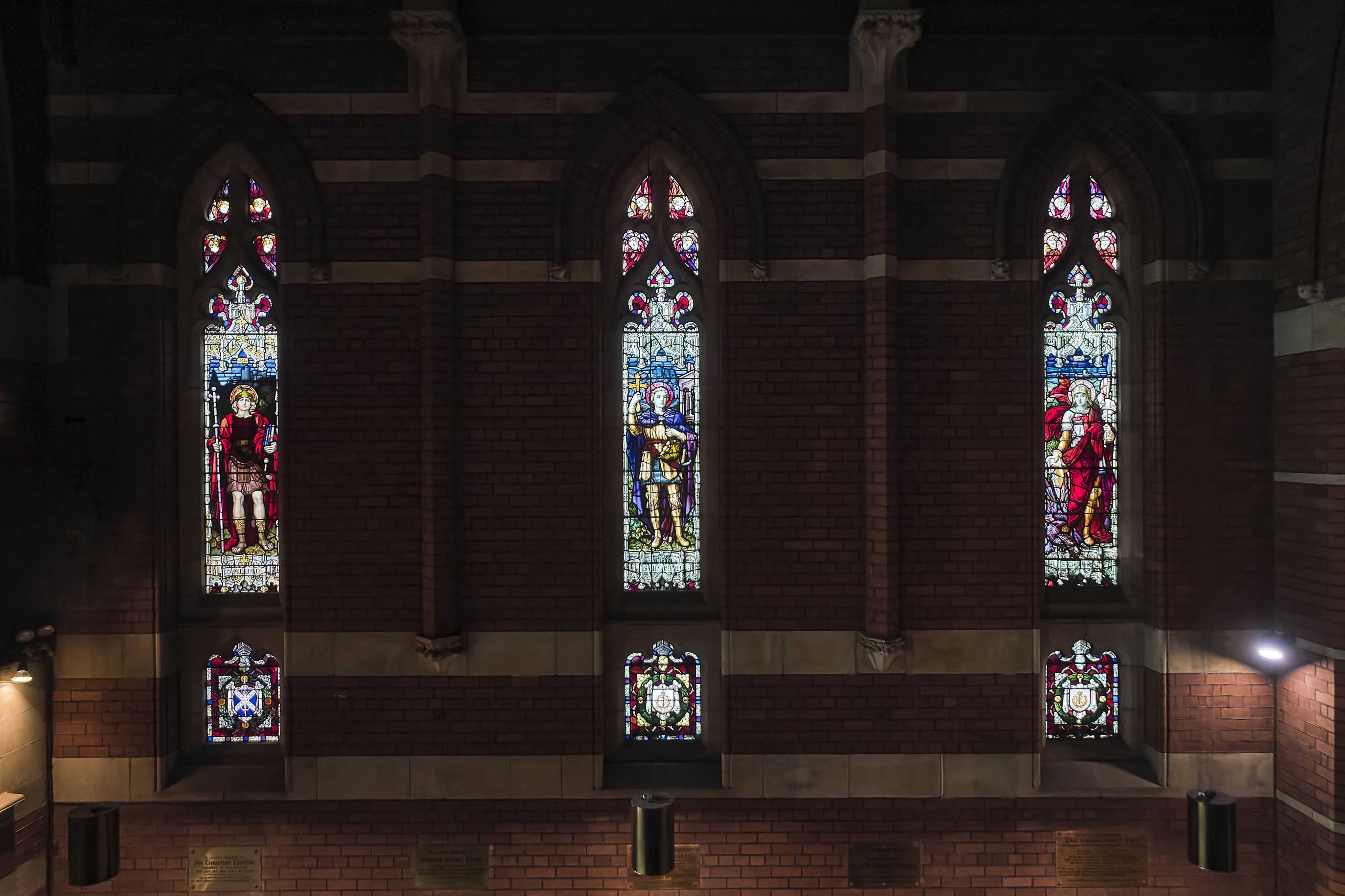
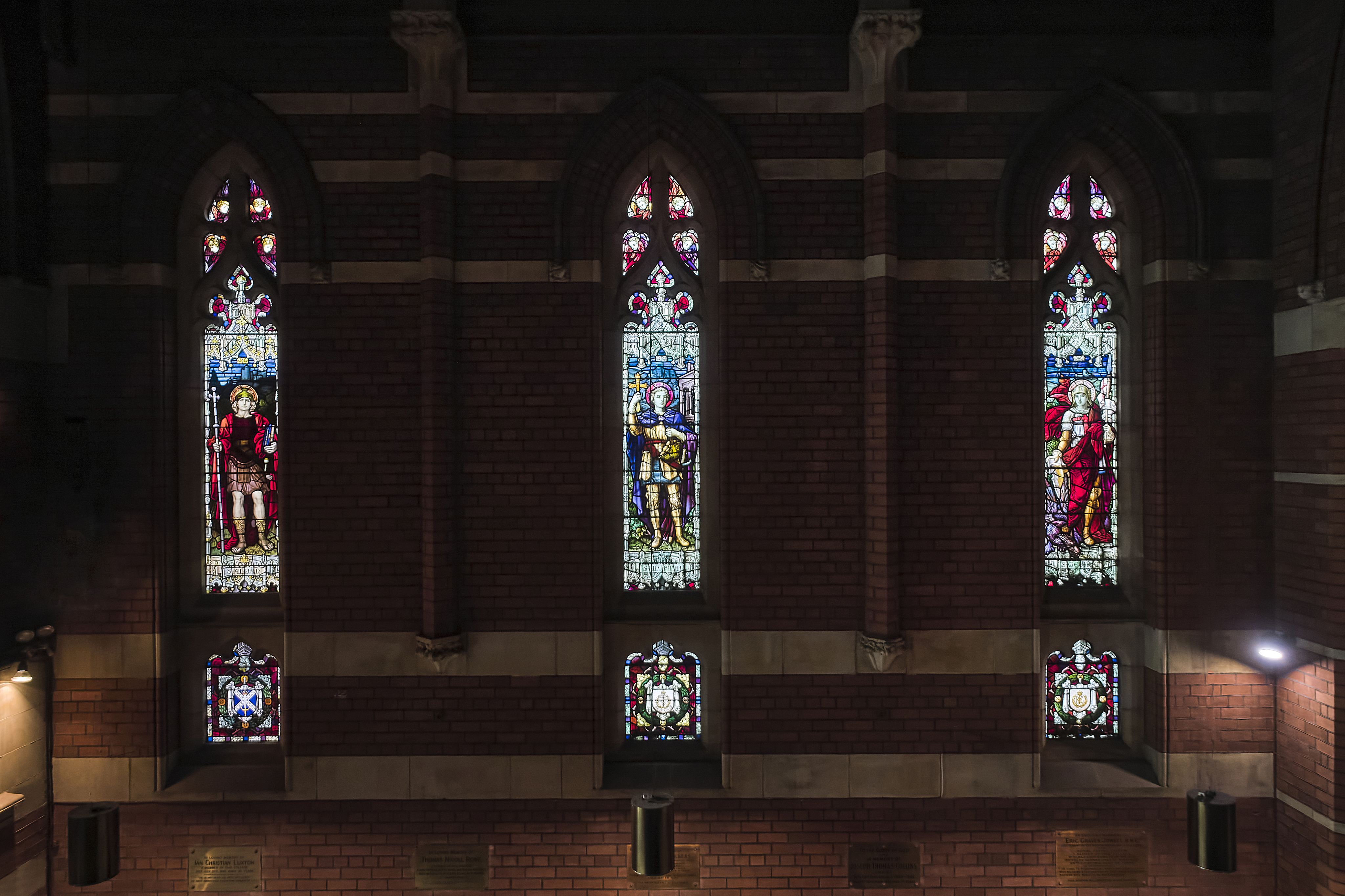
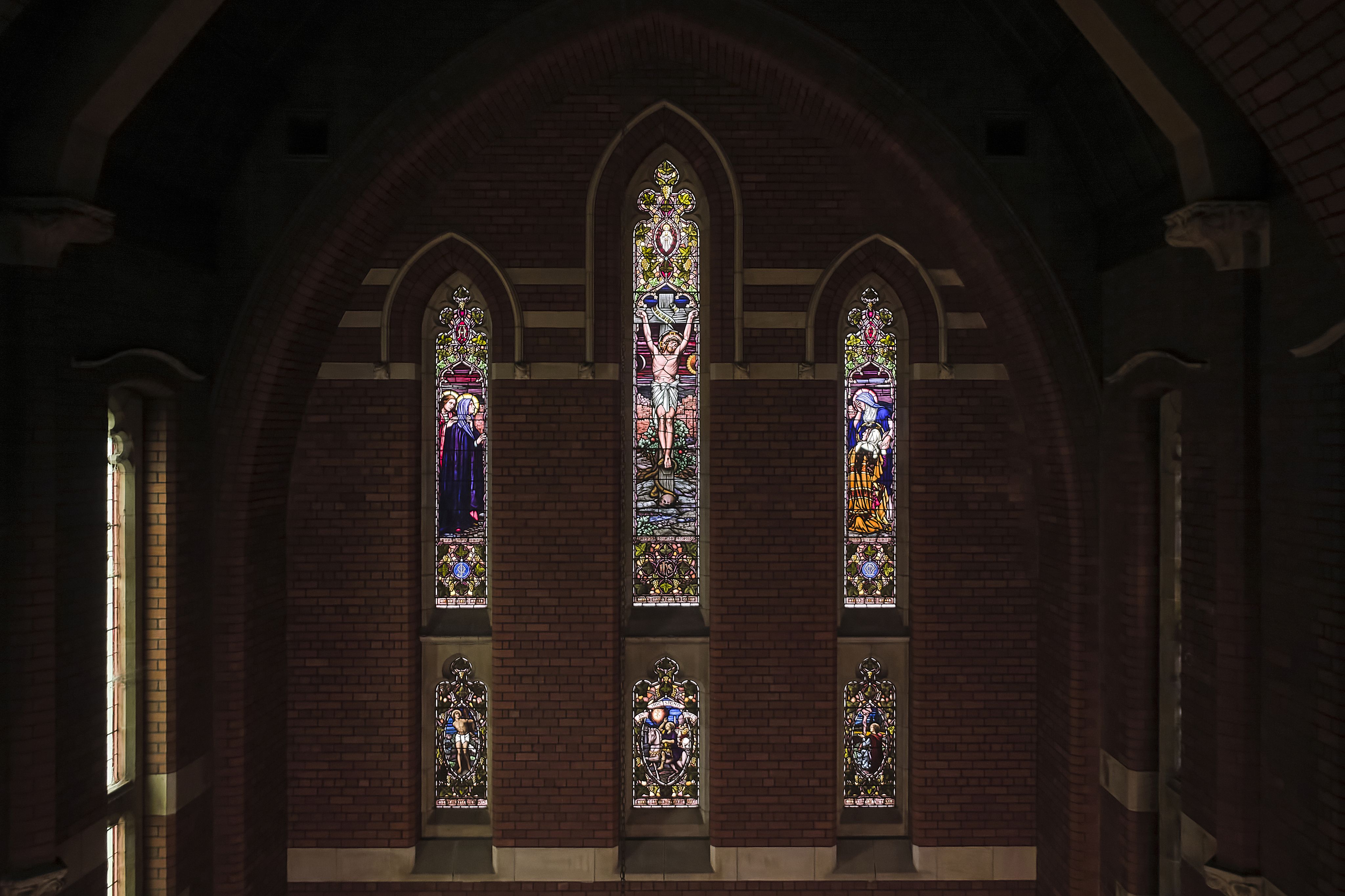
The windows in the nave have traceries filled with lauding cherubim and seraphim and base panels displaying the regimental coats of arms of the soldiers commemorated.
The north wall contains two superb windows by English artist Dudley Forsyth, St Martin of Tours (1922, Miller Memorial) and St George (1923, Jowett Memorial), plus another St Alban window (1931, Luxton Memorial) by Brooks Robinson.
The south wall has two windows by William Kerr-Morgan, of St Theodore of Heraklea (1915, Moule Memorial) and St Oswald (193, Creswell memorial), with a recent window of St Cecilia (1998, Rusden memorial) by Glenn Mack. This is the only window which does not conform to the scheme laid out at the time of the Chapel’s opening, being different in subject, style, and colouration.
The Chapel windows are tall and narrow, typical of the architect’s work, so the glass has been designed with horizontal bands of sky cutting across the lights and head and base decoration reducing the main subject to a central field. The colouration of the windows has been carefully considered, as each had to harmonise not only with the others, but with the strong red brickwork of the walls.
The College also has a set of Victorian stained glass panels depicting characters from Shakespeare by William Montgomery. They came from the opulent Brighton mansion Norwood, built in 1891 by architect Philip Treeby for the businessman Mark Moss.
The front of the house boasted a huge oriel window of thirty-five panels of Shakespearean figures. Norwood was demolished in 1955, but the Shakespeare windows were saved. Eight were acquired by the then Warden Robin Sharwood and installed at Trinity at the time of the Clarke and Bishops’ renovations in 1969–70.
The panels are of William Shakespeare, Stratford Church, Ophelia and Falstaff (installed in Clarke) and Othello, Henry VIII, Portia and a figure identified as Bassanio (installed in Bishops’). At Trinity, they were set into broad plain glass frames in the staircases of the two buildings.

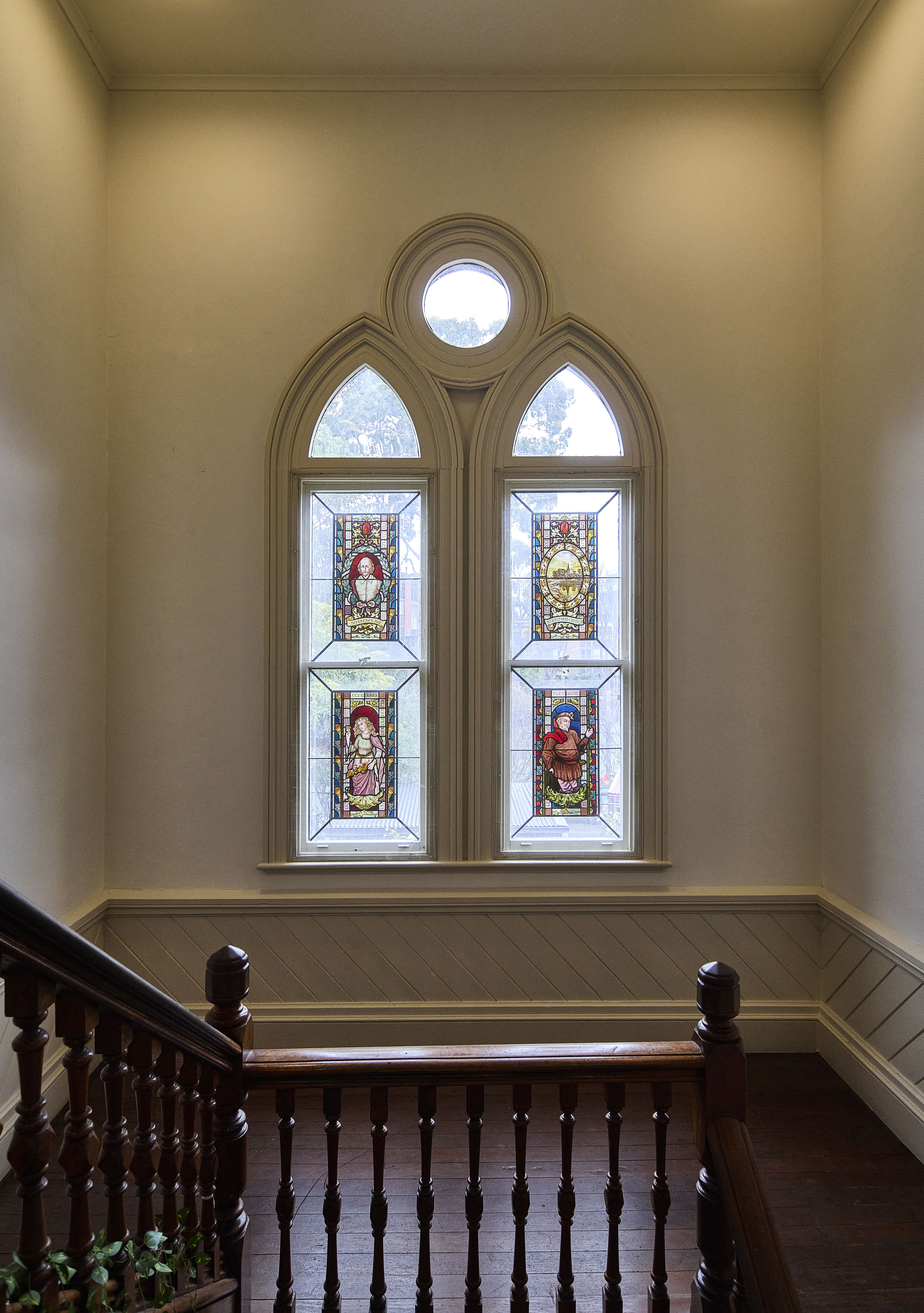
Clarke's Shakespeare window.
Clarke's Shakespeare window.
Subsequently, another two panels have been acquired: one (Katherine) was donated by Andrew Bostock in 2022 and the other (St Margaret) purchased by the College. These are now in storage.
It was a happy idea to acquire these fine panels. At the time they were made, mansions were commonly decorated with stained glass depicting landscapes, flowers and fruits or scenes from classical mythology or British history, emphasising the cultural heritage of the owners.
Shakespeare was a popular subject, and visitors and family would have entertained themselves picking out their favourite characters. Dr Leeper was president of the Melbourne Shakespeare Society and an enthusiastic promoter of the Bard, so would have been delighted that the College he loved should be embellished with them.
The variety of the College’s collection of stained glass makes it a treasure-house of Victorian and early 20th-century styles and history. The work of many hands, it embodies much of the ethos of Trinity itself.

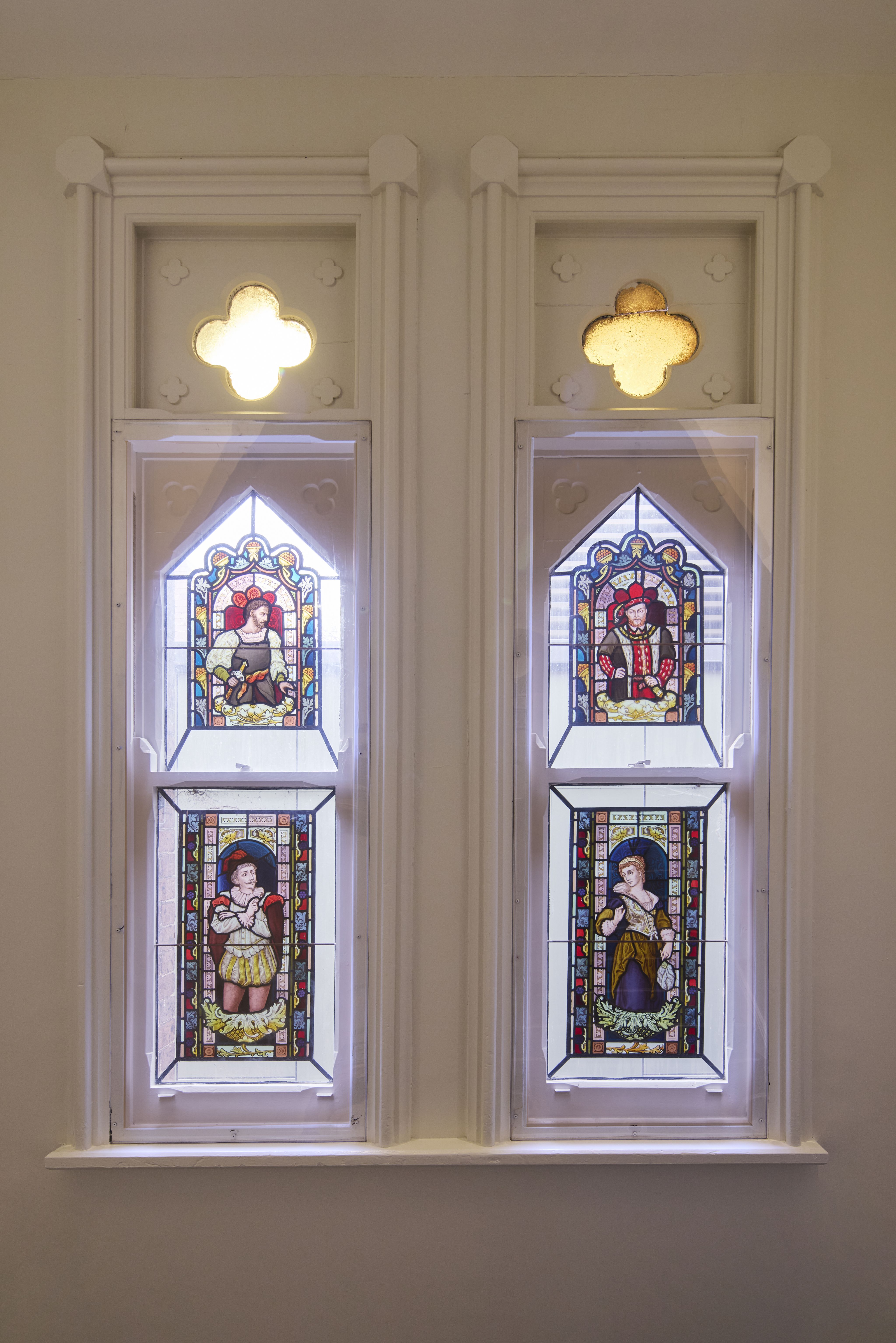
Bishops' Shakespeare window.
Bishops' Shakespeare window.
The unselfconscious ‘Englishness’ of the themes expresses the Anglican nature of the College and celebrates the faith and heritage of its founders. Saints and sinners jostle for position on its walls, continuing to survey and inspire new generations of students.
READ NEXT STORY >>> TRINITY WALKING ART TRAIL
<<< BACK TO OLD FORMS, NEW EARS
 Built with Shorthand